Delving into State Farm Auto Insurance Review: Usage-Based vs. Traditional Policies (Drive Safe & Save), this introduction immerses readers in a unique and compelling narrative, with a casual formal language style that is both engaging and thought-provoking from the very first sentence.
Providing a detailed overview of traditional and usage-based auto insurance policies, this discussion aims to shed light on the differences and benefits of each option.
Traditional Auto Insurance Policies
When it comes to traditional auto insurance policies, they are the standard type of coverage that most drivers are familiar with. These policies provide a predetermined level of coverage for a set premium amount.
Coverage Options in Traditional Policies
Traditional auto insurance policies typically include coverage for liability (bodily injury and property damage), collision, comprehensive, medical payments, and uninsured/underinsured motorist protection. These coverages offer financial protection in various scenarios, such as accidents, theft, vandalism, and more.
Cost Comparison with Usage-Based Policies
In terms of cost, traditional auto insurance policies are often priced based on factors like age, driving history, location, and type of vehicle. The premium amount is usually fixed for a certain period, regardless of actual driving habits. On the other hand, usage-based policies, such as State Farm's Drive Safe & Save program, adjust premiums based on driving behavior, potentially offering savings for safe drivers.
Advantages and Disadvantages
One advantage of traditional auto insurance policies is the predictability of premium costs, making budgeting easier for policyholders. Additionally, traditional policies offer a wide range of coverage options to tailor to individual needs. However, a disadvantage is that safe drivers may end up paying higher premiums than necessary, as rates are not based on actual driving habits.
Moreover, traditional policies may not incentivize safe driving behavior as effectively as usage-based options.
Usage-Based Auto Insurance Policies
Usage-based auto insurance policies, also known as telematics insurance, are policies that use technology to monitor a driver's behavior behind the wheel. These policies take into account factors such as mileage driven, speed, braking patterns, and time of day when determining insurance rates.
How Usage-Based Policies Work
Usage-based policies utilize devices or smartphone apps that track driving habits. These devices collect data on acceleration, braking, cornering, and speed, which is then used by insurance companies to assess a driver's risk level. This data is then used to adjust premiums based on how safely the policyholder drives.
Cost Savings of Usage-Based Policies vs. Traditional Policies
One of the primary benefits of opting for a usage-based policy is the potential for cost savings. By demonstrating safe driving habits, policyholders can qualify for discounted rates compared to traditional auto insurance policies. The more responsibly a driver behaves on the road, the more they can save on their premiums.
Benefits and Drawbacks of Opting for a Usage-Based Policy
- Benefits:
1. Personalized premiums based on individual driving habits.2. Incentives for safe driving behavior. 3. Potential cost savings for responsible drivers.
- Drawbacks:
1. Privacy concerns related to the collection of driving data.2. Limited discounts for high-risk drivers. 3. Reliance on technology that may have glitches or inaccuracies.
State Farm Drive Safe & Save Program
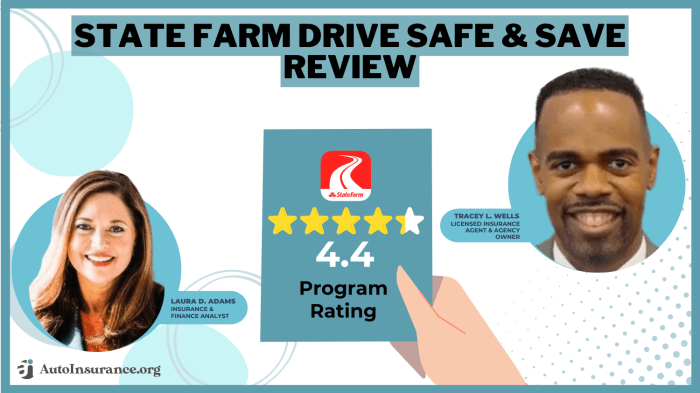
State Farm's Drive Safe & Save program is designed to reward safe driving habits by offering discounts on auto insurance premiums based on individual driving behavior. The program utilizes telematics technology to track driving habits and provide personalized feedback to policyholders.
How the Program Tracks Driving Habits
The Drive Safe & Save program uses a small device that plugs into the vehicle's onboard diagnostic port to monitor driving habits such as speed, acceleration, braking, and time of day
- The device collects information on mileage, driving speed, acceleration, braking, and time of day.
- Policyholders can access their driving data and discount details through the State Farm mobile app or online portal.
- The program also provides feedback on driving habits to help policyholders improve their safety on the road.
Customer Reviews and Feedback
Many customers have reported positive experiences with the Drive Safe & Save program, noting that it has helped them become more aware of their driving habits and ultimately save money on their auto insurance premiums. Some have praised the program for its transparency and ease of use.
One customer mentioned, "I love how the Drive Safe & Save program encourages me to drive more cautiously and rewards me for it. It's a win-win!"
Limitations and Criticisms
While the Drive Safe & Save program has been well-received by many policyholders, some have raised concerns about privacy issues related to the collection of driving data. Additionally, there have been instances where technical issues with the tracking device have led to inaccurate data being recorded, resulting in disputes over discounts.
- Privacy concerns have been raised regarding the collection and use of driving data for determining discounts.
- Some policyholders have experienced technical issues with the tracking device, leading to discrepancies in their discount calculations.
- There have been criticisms of the program for not taking into account external factors that may affect driving behavior.
Choosing Between Usage-Based and Traditional Policies
When deciding between usage-based and traditional auto insurance policies, there are several factors to consider to ensure you are selecting the most suitable option based on your individual driving habits.
Factors to Consider:
- Frequency of driving: If you drive frequently, a traditional policy might be more cost-effective compared to a usage-based one that often rewards low-mileage drivers.
- Driving behavior: Usage-based policies track your driving habits, such as speed, braking, and time of day you drive. If you are a safe driver, opting for a usage-based policy could lead to potential discounts.
- Budget: Evaluate your budget and determine which policy aligns better with your financial goals and needs.
Scenarios to Consider:
- Traditional Policy: If you have a predictable driving routine and maintain safe driving practices consistently, a traditional policy might offer more stability in terms of premiums.
- Usage-Based Policy: For drivers who have sporadic driving patterns or are confident in their safe driving habits, a usage-based policy could result in substantial savings.
Real-Life Examples:
- John switched from a traditional policy to a usage-based one and saw a significant decrease in his premiums after driving responsibly and meeting the program's requirements.
- Sarah, on the other hand, found that her traditional policy was more suitable as she had a long daily commute and preferred the predictability it offered in terms of insurance costs.
Last Point
In conclusion, navigating between traditional and usage-based auto insurance policies can be a complex decision. By understanding the key factors and considerations discussed in this review, individuals can make informed choices that best suit their driving habits and financial preferences.
Commonly Asked Questions
What are traditional auto insurance policies?
Traditional auto insurance policies offer standard coverage for vehicles based on factors like age, make, and model.
How do usage-based auto insurance policies work?
Usage-based policies track driving behavior through telematics devices or mobile apps to determine premiums based on actual usage.
What is State Farm's Drive Safe & Save program?
State Farm's Drive Safe & Save program monitors driving habits to potentially lower insurance rates for safe drivers.
What factors should be considered when choosing between usage-based and traditional policies?
Factors to consider include driving habits, mileage, and comfort with sharing driving data.
Can you switch between traditional and usage-based policies easily?
It is possible to switch policies, but individual circumstances and the insurer's policies may affect the process.